When I was six years old, my first exposure to martial arts was a disaster. There was no actual teaching — just full-contact fighting. As a child living with dyspraxia and poor coordination stemming from a toddler brain injury, that environment offered no entry point for me. It wasn't until years later, in 1995, that I stepped into a Tang Soo Do Dojang run by instructor Chris Long. That was the moment everything shifted. For the first time, I realised that dedicated hard work could overcome physical limitations. Tang Soo Do didn't just give me coordination; it gave me resilience, purpose, and a lifelong calling.
Fast forward through earning my 1st Dan in 1999, stepping into instruction in 2010 with five students in a hired hall, and eventually opening a full-time studio in 2019. Today, as a 4th Dan instructor at Heads of the Valleys Tang Soo Do in Abergavenny, Wales, my mission is simple: #martialartsforall. But as my teaching expanded, so did my frustration with a glaring issue in the traditional martial arts world — the divide between pre-arranged forms (Kata or Hyung) and practical, functional application.
The Problem with Static Training
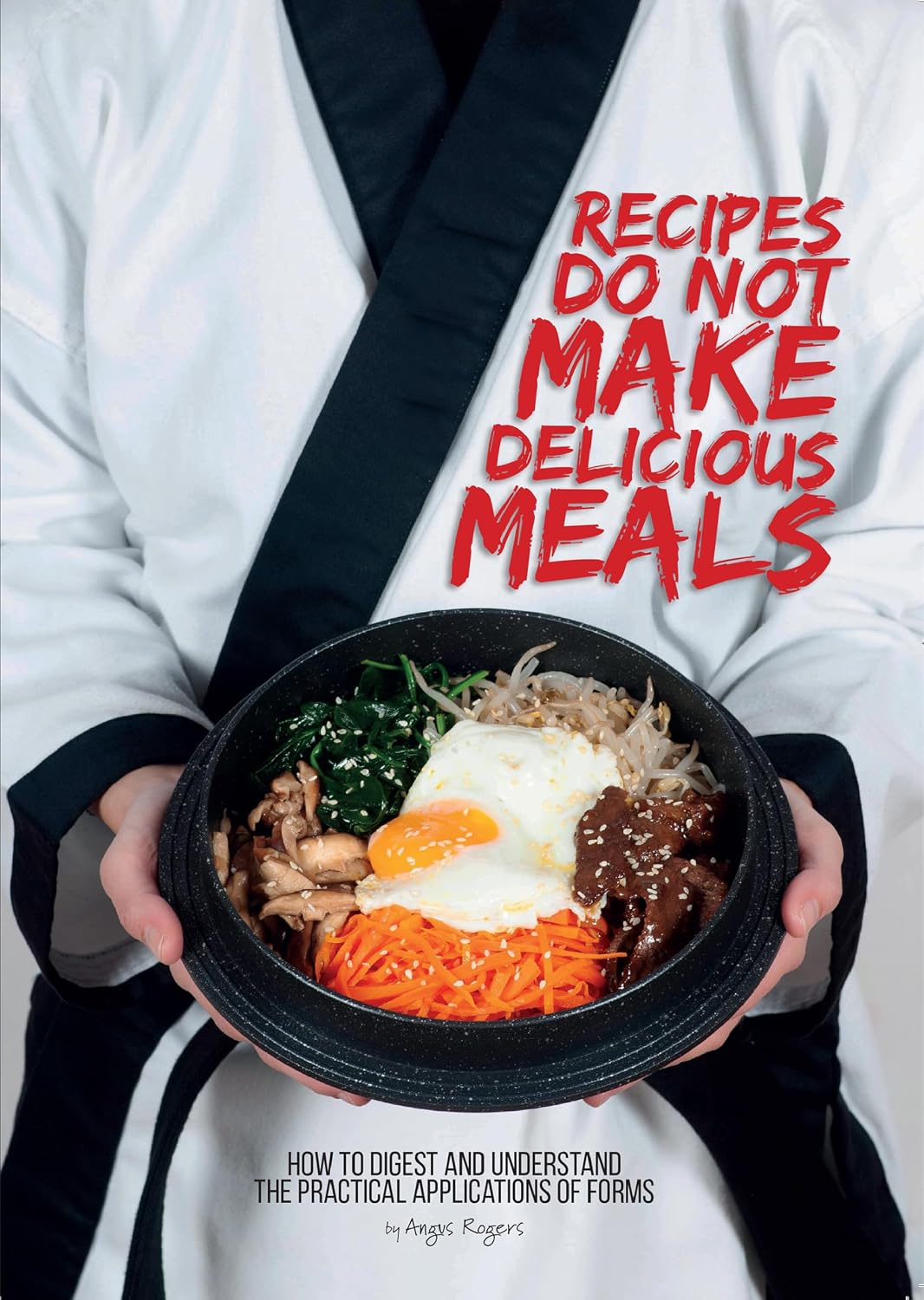
Too often, traditional martial arts are taught like a strict culinary recipe: follow the steps precisely, and a perfect outcome is guaranteed. But as the title of my new book suggests, Recipes Do Not Make Delicious Meals. Knowing the steps of a form does not make you an effective martial artist any more than reading a cookbook makes you an executive chef.
Traditional syllabi often trap practitioners in rigid performance art. We practice block-and-punch combinations against imaginary opponents, yet when a student transitions to live sparring, competition, or real-world self-defence, the disconnect becomes painfully obvious. The forms aren't flawed — the way we interpret and teach them is.
In my book, which focuses on the fundamental "Peace and Safety" (Pinan/Heian) forms created by Anko Itosu, I break down the training matrix from White Belt to Black Belt. The goal is to strip away the performance fluff and extract the underlying mechanics: close-quarters striking, joint manipulation, takedowns, and limb control embedded within the movements.
To bridge the gap between static text and dynamic practice, I integrated QR codes throughout the book that link directly to video demonstrations. Readers can watch the practical applications in real time and reach out directly to start a dialogue. Martial arts shouldn't be preserved like a museum artefact — it should be a living, breathing, evolving conversation.
The Competition Crucible: Testing the Philosophy
This philosophy of functional adaptation is also what drives my approach to competition. I have the opportunity to travel to the first ever Tang Soo Do competition in Korea. Even though the art was created and developed in South Korea in the 1960s, it was either turned into Taekwondo or its instructors left to teach around the world. In 2024, I had the opportunity to visit Korea on holiday, and while there I found a Korean Karate Dojang where I trained — and it was incredible. But I never thought a Tang Soo Do tournament on Korean soil was even possible. So I'm so excited to go over, train for two days, then compete alongside Koreans and students from around the world.
It is a huge opportunity and I'm deeply honoured and privileged to represent Wales in the first ever Tang Soo Do tournament in the country where the art was born. I love to test myself and set an example to my students. If the event is successful, I hope others will make this trip and experience it too.
Whether you are stepping onto the mats in South Korea or working live drills in the Dojang, competition serves as a critical pressure test. It forces you to abandon rigid patterns and adapt instantly to a resisting opponent. Competition isn't separate from traditional forms; it's the proving ground where static "recipes" are tested against real-world timing, distance, and pressure.
Why Traditional Arts Must Evolve
If traditional arts like Tang Soo Do, Karate, or Taekwondo are going to remain relevant alongside combat sports like BJJ, MMA, and Muay Thai, we have to stop hiding behind tradition as an excuse for impracticality.
We need to embrace cross-context training. In my classes, high-energy sessions cover everything from traditional forms to practical self-defence, weapon defence, and autism-specific training. After every grading, we run a "Fun Class" — completely off-syllabus — to experiment, play, and test ideas.
The traditional arts aren't dying, but they do need a reboot. We don't need to throw away our history or our forms; we just need to stop treating the recipe as the final meal.